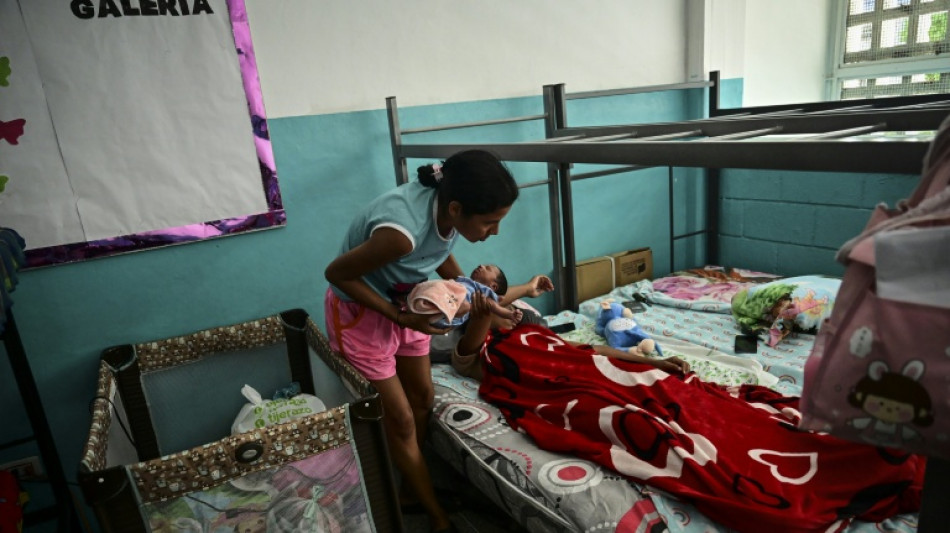
In Venezuela's quake ruins, a baby is born / Photo: MARTIN BERNETTI - AFP
Eliana Garcia, 38 weeks pregnant, ran with her family to a baseball field on the afternoon of June 24 when the earth shook violently in La Guaira, on the Venezuelan coast where twin earthquakes hit hard.
As they sought refuge, along with dozens of others avoiding streets lined with buildings collapsing around them, the 19-year-old felt fluid trickling between her legs.
Doctors had already told the first-time mother that she couldn't give birth naturally because of her narrow pelvis. A cesarean section was scheduled for a week later, but then the contractions began.
"I felt like I needed to pee. But I pushed and pushed, and when nothing came out, I understood that the baby was coming," Garcia told AFP in a shelter.
Those fleeing with her laid her down on the only sheet they managed to grab in the chaos, a protective instinct given her advanced pregnancy.
It was the early morning of June 25. In the dark and barefoot, her sister-in-law, Julia Di Giuseppe, went to look for help.
Around her, the coastal city was now a cacophony of shouts and cries, as rescuers scaled the ruins to help people trapped in buildings, and motorcycles zigzagged through the rubble after the earthquakes collapsed scores of structures.
- No water or electricity -
No one listened to Di Giuseppe's calls for help. She returned to the baseball field just in time to hear her sister-in-law start to give birth in the midst of a series of aftershocks.
"I begged a paramedic who was searching for her family members in the ruins, and she started helping," the 37-year-old woman said.
Without water or surgical gloves, and only hand sanitizer for hygiene, the paramedic assisted in the delivery, illuminated by the lights of cell phones that still had battery power.
Garcia, surrounded by dozens of people who forgot their personal tragedies for a few minutes, began to push.
When the baby was born -- a boy, to the surprise of the family, who were expecting a girl -- he did not cry immediately.
But as the crowd of onlookers burst into applause, suddenly he started to wail.
The next item of business was to cut the umbilical cord, but with no tools at hand, "people started taking out their hair bands and we tied it at both ends, with a lot of alcohol," Di Giuseppe recalled.
They later cut it with a pair of nail scissors.
Garcia, who is separated from the baby's father, doesn't remember anything else from that point on.
Her family transported her as best they could, first in their arms, then in a motorized garbage cart, and finally in an ambulance all the way to a public hospital.
The doctors were overwhelmed by the earthquake victims, but nonetheless attended to her.
The entire family was relocated to a public school serving as a shelter in La Guaira, the coastal region hardest hit by the 7.2 and 7.5 magnitude earthquakes that have already left nearly 3,700 dead and thousands still missing.
Di Giuseppe broke down in tears as she watched Eliana breastfeeding her son.
"We saved him, but we lost our two nieces," she said.
The girls, 14 and 11 years old, were found in the rubble of the apartment building where they lived.
Disfigured by tons of concrete, their father recognized them only by the silver bracelet the older girl wore on her wrist.
The girls' mother, Garcia's sister, and a nephew are still missing.
Eliana had been planning to name her baby Daniel Eduardo if it were a boy.
"But my sister always told me to name him Gael," the young woman sobbed. "So, for her sake, I decided to name him Gael Jesus. It's my way of having her here with me."
Q.Henao--BT