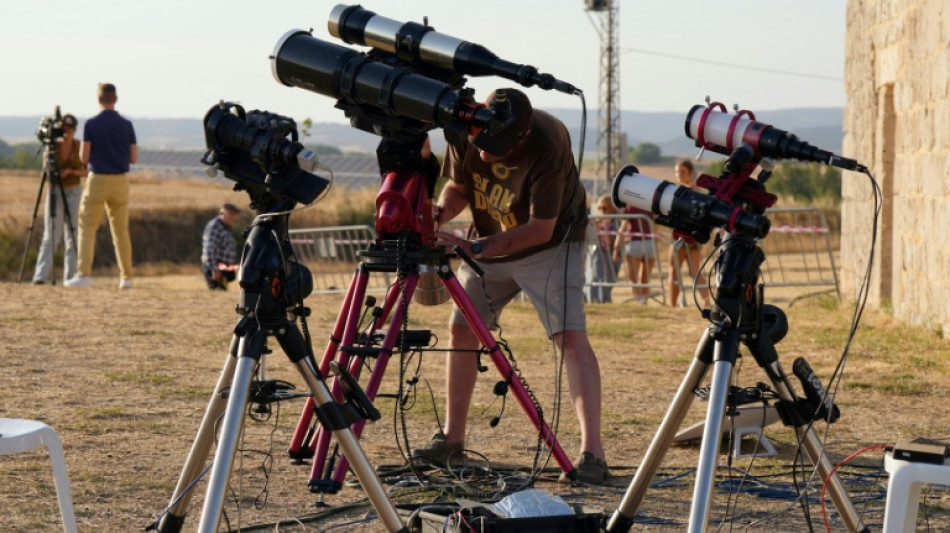
Skywatchers gather in Europe to see total solar eclipse / Photo: Cesar MANSO - AFP

The streets of typically quiet Spanish villages were clogged by skygazing tourists on Wednesday in anticipation of a rare total eclipse that would plunge areas into an eerie daytime darkness.
The shadow cast when the Moon blots out the Sun will begin in Russia's remote Arctic north at around 1700 GMT and continue in an arc over Greenland and Iceland.
In Spain, where the total eclipse will be best viewed, the shadow will cross the country diagonally from the northern Atlantic coast to the Mediterranean Sea, where it will vanish at around 1830 GMT.
Science teacher Ana Cots, 51, travelled all the way from the United States on a family holiday for the "wonderful opportunity", adding she looked forward to sharing the experience with her students.
This will be mainland Europe's first total eclipse since 2006, and more than a century since one was witnessed in mainland Spain.
Yenny Guevera, a 50-year-old Peruvian living in France, was undeterred by her lack of accommodation when she arrived in Burgos early on Wednesday.
"It's the first time and it's the last time, the only time I'm going to see an eclipse," she said enthusiastically.
Self-described "eclipse chaser" Lucie Green was ready to watch from a boat off the island of Mallorca.
"People do get addicted to it because it is such a moving experience," the British solar physicist told AFP.
Millions more observers will see a partial eclipse, visible in most of Europe, Canada, the northern United States and northwest Africa.
- Fleeting phenomenon -
Throughout human history, eclipses have stirred amazement, fear and reverence, as they appear to momentarily halt the normal course of nature.
The shadow cast by the alignment of Sun and Moon creates a strange twilight during which temperatures drop, shadows appear at strange angles and some animals go to sleep.
But the phenomenon is fleeting: for observers in Spain, the total eclipse will last less than two minutes just before sunset.
In parts of Russia and Greenland it will be slightly longer, though still under two-and-a-half minutes.
The partial eclipse -- which occurs as the Moon starts and finishes crossing the Sun's path -- will last around one hour and 45 minutes.
The phenomenon will present scientists with a rare opportunity to study the Sun's atmosphere and its outermost layer, as they seek to uncover secrets about solar winds and our star's magnetic field.
- Eclipse fever -
Eclipse chasers were rushing to secure a vantage point.
Rain and clouds were forecast to spoil the occasion in the Westfjords region of northwestern Iceland, while Reykjavik, the capital, was set to experience its first total eclipse since 1433.
Further south, Spain's AEMET weather agency has predicted clear skies for most of the country.
Eclipse fever is gripping Spain, with the type of glasses certified to safely view the Sun hard to find in some places.
The net contribution to the economy from the phenomenon is forecast to be 347 million euros ($400 million), with more than 446,000 extra tourists, the economy ministry said.
"The path of totality is very narrow. It's only a couple of hundred kilometres wide," British astrophysicist and science communicator Graham Jones told AFP Tuesday from Fontanil de los Oteros.
"That's what's so special about Spain. The path of totality really goes across the Spanish peninsula."
Burgos resident Mario Alejos, 44, agreed, saying "it's like a gift for us".
He saw a previous eclipse as a child and was excited to relive the moment with his family. "We have to take advantage of it."
- Hazards on horizon -
With temperatures expected to top 35C Wednesday in most of Spain and above 40C in the northeast, there are fears for those spending hours outdoors.
AEMET also forecasts a "very high" or "extreme" wildfire risk for much of the country -- amplified by thousands of people in parched countryside and clogging small rural roads with cars.
Officials expect there to be as many as 1.5 million extra road journeys towards the band of totality.
Dedicated observation points have been set up and security increased.
Another total eclipse will cross southern Spain and northern Africa in August 2027, while an annular eclipse -- when the Moon is not big enough to completely blot out the Sun, creating a so-called "ring of fire" -- is due to visit the Iberian Peninsula in 2028.
burs-imm/ds/giv/phz
O.Florez--BT