Japan’s Last Condom Machine Repairers Face an Enduring Decline

Atsushi Takahashi, a veteran repairman at Sagami Rubber Industries, tends to aging condom vending machines in Kanagawa Prefecture. Once numbering 30,000 nationwide, these machines have dwindled to a fraction of their peak as retail habits shift toward drugstores and online platforms, leaving a small team to maintain the disappearing infrastructure.
Atsushi Takahashi stands in the workshop of Sagami Rubber Industries’ headquarters in Atsugi, Kanagawa Prefecture, surrounded by rows of aging condom vending machines. Some are freshly restored, waiting to return to storefronts; others sit in various stages of disassembly, their parts stripped for reuse. Takahashi, 57, has spent the last 15 years as one of the few people in Japan capable of repairing these specific units.
“These machines will soon go to heaven,” he says, gesturing toward a row of units considered beyond repair. He describes the refurbished machines as “newborn children” and the scrapped ones as having reached the end of their lives. Inside the workshop, about 40 machines occupy the space, representing a dying industry that once defined a significant portion of Japanese retail culture.
Sagami Rubber states it is the only condom manufacturer in Japan that still repairs its own vending machines. The company employs a three-person repair team for this task, with Takahashi noting that the average age of the group is 63, including the oldest member, who is 71. He describes the repaired units as “our children,” reflecting a personal investment in machinery that Japanese companies ceased producing about 25 years ago.
The decline of these machines mirrors a broader shift in consumer behavior. At their peak in the early 1990s, condom vending machines numbered approximately 30,000 nationwide. They were a familiar sight on street corners, positioned outside pharmacies, liquor stores, and neighborhood shops. Featuring slogans such as “Your life will change with 0.02 millimeters” and “A bridge of love,” the machines offered a discreet, 24-hour alternative for purchasing contraceptives at a time when many consumers felt uncomfortable buying them face-to-face.
Sagami Rubber began manufacturing these vending machines in the 1970s, primarily installing them outside independently owned pharmacies. At their height in 1993, the nationwide market generated an estimated 4 billion yen ($255 million) in annual sales. Sagami Rubber alone managed about 10,000 of those units.
Today, that landscape has changed dramatically. By June 2026, Sagami’s machine count had fallen to 1,540. Sales through these machines have also plummeted. According to company data, sales dropped from 1.14 million condoms worth 105 million yen in fiscal 2018 to 410,000 units worth 51 million yen in fiscal 2025. Nationwide, the company reports that only three or four machines generate more than 10,000 yen in monthly sales.
“The challenge now is figuring out how to reshape the business so that it remains viable,” said Muneto Tamagami, a director at Sagami Rubber. He acknowledged that while the vending machine business is not rational as a profit center, the company cannot simply shut it down. “As long as there are customers buying from them, we can’t simply shut it down. It remains a sales method that serves users’ needs.”
The repair process itself has become increasingly difficult. When stores close or machines require replacement, old units are sent back to the factory in Atsugi. The team strips them for parts and refurbishes about 10 units a month. Takahashi explains that even if 100 machines return, approximately 30 have no usable parts left and must be scrapped. From the remaining 70, the team gathers every component possible to bring them back to life.
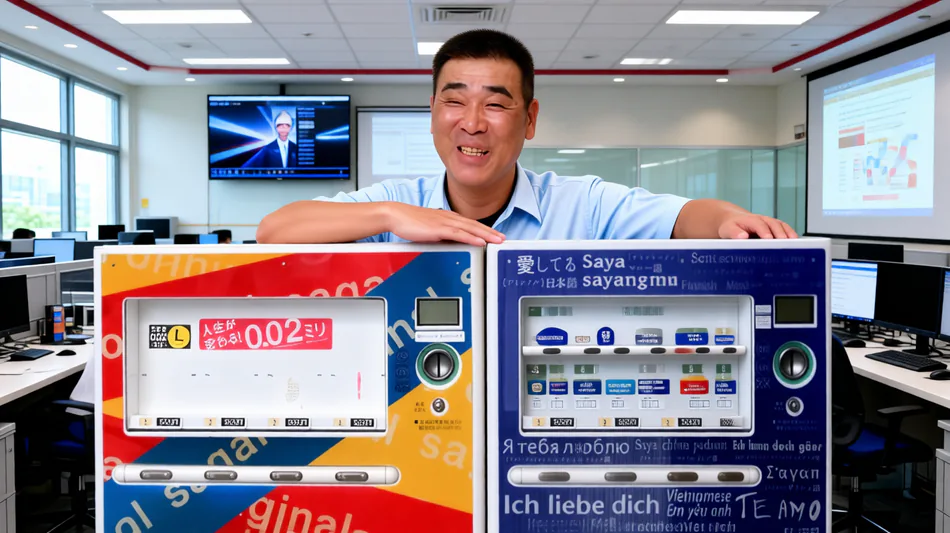
Outside the headquarters, Takahashi maintains one of the few remaining machines personally. He occasionally changes its display panel “depending on my mood.” In a moment of levity, he poses with his face sticking through an opening in a panel, joking, “I feel like I’ve become a vending machine. I wonder who’s coming today?”
The decline is not unique to Sagami Rubber. Rival manufacturer Okamoto Industries Inc., once known for the slogan “Bright family planning,” operated roughly 10,000 machines at its peak. Today, it maintains about 250. Shoma Wada, who oversees the condom business at Okamoto, emphasizes that condoms remain essential for both contraception and preventing sexually transmitted infections.
Wada, who also serves as a guest lecturer in sex-education classes at junior high schools, notes that parents often struggle with how to discuss these topics with their children. He recalls buying his first condom from a vending machine in junior high school, partly as a joke, and notes that they were once installed outside liquor stores, becoming part of the scenery of everyday life. “When young people became curious about sex, vending machines allowed them to encounter condoms naturally,” he said.
Takahashi understands the reasons for the machines' disappearance. The proliferation of convenience stores allows people to buy condoms anytime, while online shopping enables purchases without face-to-face interaction. However, he believes the machines hold cultural significance beyond their utility. “I think condom vending machines are part of our culture. I imagine there are other people besides me who would feel sad if they disappeared,” he said.
Despite the decline, Takahashi keeps track of many of the scattered machines across Japan. “It makes me happy when I see one still standing where it used to be,” he said. “When it’s gone, I feel sad.” When asked what message he would leave for customers, he paused before responding: “For buyers, it may seem like it’s the same wherever you purchase one. But when the moment comes, there’s always the vending machine!”
The situation reflects broader challenges facing Japan's vending machine industry. While drink vending machines face rising costs and new banknotes impact small businesses, specialized units like those for condoms struggle with shifting retail dynamics. Other niche vending sectors, such as bento boxes and perfume, are adapting through technology like AI assistants, but the traditional condom machine remains a relic of a different era.
As the remaining units continue to age, the repair team at Sagami Rubber works to extend their lives. The machines, once symbols of discreet access to sexual health, now serve as a testament to a changing consumer landscape where convenience and privacy are increasingly met by digital platforms rather than mechanical boxes on street corners.
Z.Marin--BT