Activists pressure Milan Fashion Week to go fully fur-free / Photo: Miguel MEDINA - AFP

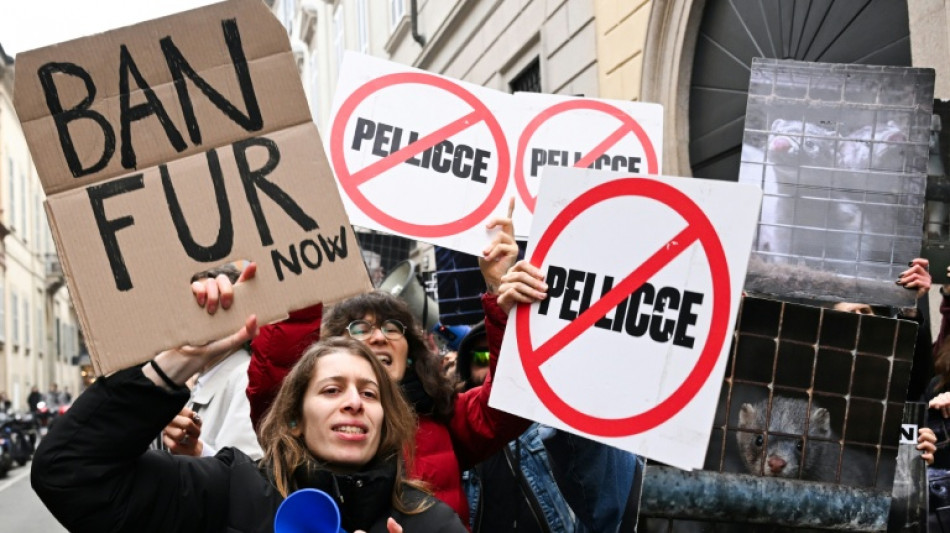
Animal activists have been turning up the heat on Milan Fashion Week to adopt a fully fur-free policy, with dozens of protesters demonstrating outside the Giorgio Armani show on Sunday.
Although the Armani Group went fur-free a decade ago, activists hope the powerful luxury company can pressure the National Chamber of Italian Fashion (CNMI), which organises fashion week, to disallow brands which use fur from participating.
Sunday's demonstration was one of several protests carried out this week in Milan by international anti-fur activists organised under the Coalition to Abolish the Fur Trade (CAFT).
Behind a barricade and large banner saying "Milan Fashion Week Go Fur-Free", activists with a megaphone yelled "Shame on you for what you do!" as Armani guests left the show.
Use of fur in the global fashion industry has dramatically fallen in recent years due to concerns about animal cruelty, changing trends and new synthetic alternatives.
But there remain notable holdouts, such as Fendi, owned by French conglomerate LVMH, a storied Italian luxury brand whose roots are in fur.
Pierre-Emmanuel Angeloglou, the chief executive of Fendi, sits on the board of directors of the CNMI along with brands like Dolce & Gabbana, Prada and Ermenegildo Zegna, which have already rejected fur.
Campaigners hope the anti-fur designers can convince Milan Fashion Week to ban fur, as London and New York have done.
Smaller fashion weeks, including in Berlin, Copenhagen and Amsterdam, have also gone fur-free.
"It won’t be Fendi that helps us reach our goal, because they have no interest in pushing this issue forward, but other brands might be able to contribute," Alberto Bianchi, 25, one of the protest's organisers, told AFP.
The CNMI did not respond to an AFP request for comment.
- Step forward? -
The activists had demonstrated Wednesday outside Fendi's Milan headquarters where its runway show took place.
Inside, newly seated designer Maria Grazia Chiuri showed a collection that included "remodelled" furs, or old furs reworked.
Bianchi said that focus on recycling could possibly be seen as "a step forward" but cautioned that LVMH is still actively investing in the use of fur.
"I see it as a one-off move maybe to do a bit of greenwashing," he said.
"As long as we still have fur farms in Europe and we still have the possibility of importing it, it’s a gesture that doesn't change the underlying idea," Bianchi added.
The coalition won a victory in late January when pressure campaigns led to shipping giant DHL and cosmetics company Wella withdrawing as sponsors of Milan Fashion Week.
Later this month, the European Commission is expected to rule on a 2023 citizens' initiative that called on the EU to ban fur farms and the killing of animals such as mink, foxes, raccoon dogs or chinchillas solely for their pelts.
Activists cite the cruelty inherent in fur farming, in which the animals are crammed into tiny wire battery cages before being gassed or electrocuted.
Milan Fashion Week ends on Monday, with focus now turning to Paris Fashion Week -- which similarly does not have an anti-fur policy.
W.Cano--BT