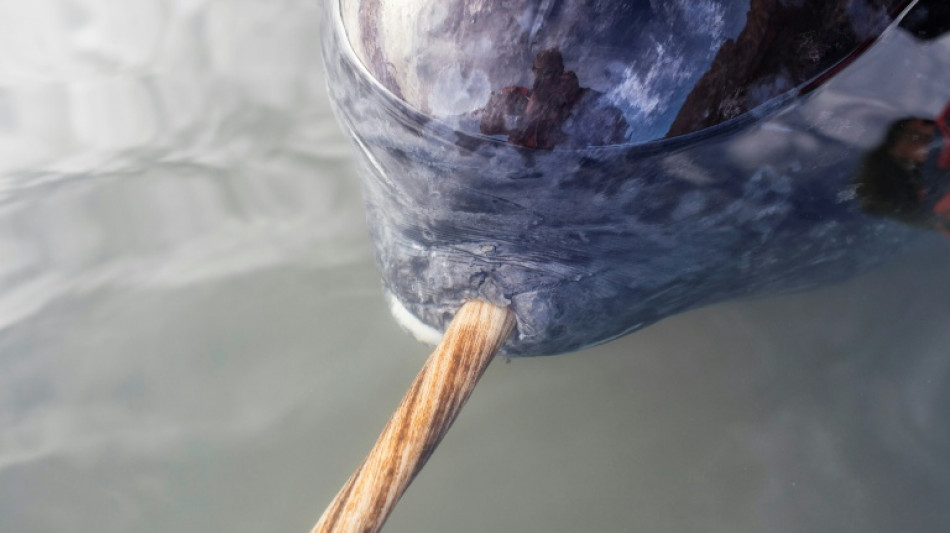
Scientists discover how narwhals grow nature's only straight tusk / Photo: Mads-Peter Heide JORGENSEN, Mads-Peter Heide JORGENSEN - Greenland Institute of Natural Resources/AFP

Narwhals have nature's only straight tusk, a single tooth up to three metres long so strange they were sold as magical unicorn horns during the Middle Ages.
The tusks have fascinated scientists ever since, but they have proven extremely difficult to study because these odd-looking, blubbery whales spend most of their lives under the Arctic ice.
But on Tuesday, a large international team of researchers announced they had solved a long-running mystery about the tusks: how they get their uniquely spiralled yet arrow-straight form.
The left canine tooth of male narwhals grow through their jaw and upper lip, jutting out into the animal kingdom's only single tusk. Their right canine stays buried in their head.
"Imagine that you had to ride on a bicycle with a broom strapped to your head," said Henrik Birkedal, the senior author of a study in Nature Communications describing the new discovery.
That is how it must feel for male narwhals to dive deep underwater, the chemist at Aarhus University in Denmark told AFP. Yet despite this huge "Monty Pythonesque" protuberance, the animals seem to get about just fine, he added.
To solve what they called the "narwhal tusk puzzle," the team of biologists, chemists and physicists used advanced 3D X-ray technology, including three European particle accelerators called synchrotrons.
The tusks are made out of two kinds of dental tissue: dentin on the inside, cementum on the outside.
On a molecular level, the inner dentin forms a right-handed spiral while the outer cementum forms a left-handed spiral, the powerful X-ray scans revealed.
These two counter-acting forces give the tusks the straight structure that is so different to the curved tusks of other animals such as elephants.
"Imagine you turn a screw into a piece of wood, and with each turn, the screw penetrates deeper," Birkedal explained. Narwhal tusks are similar -- except the screw is pushing further out from the animal's head.
The scientists were also surprised to find growth layers similar to tree rings inside the tusks, which offer a glimpse into their lives that can last up to 80 years.
To conduct the research, they used tusks from museums as well as those collected by Greenland's indigenous Inuit people, who hunt narwhals for food.
- But what are they for? -
This was not the only lingering mystery about narwhal tusks. There has also been great debate between scientists about the exact purpose of the world's weirdest tooth.
There are several hypotheses, including that the whales use their tusks for hunting or to sense temperature and salinity in the water.
But the team behind the new paper believes these options are unlikely because tusks are almost exclusively grown by male narwhals -- and females would have needed them also for these purposes.
Two males have been observed engaging in what appeared to be a tusk-measuring contest in front of a female, suggesting they could be used to establish dominance and impress a potential mate.
"This is definitely the most likely purpose of the tusk," study co-author Mads-Peter Heide Jorgensen of the Greenland Institute of Natural Resources told AFP.
Leading narwhal tusk expert Martin Nweeia, who was not involved in the new study, strongly disagreed.
"The primary function of this tusk is as a sensory organ system," the Harvard University dental anthropologist told AFP, pointing to his past research.
Despite this disagreement, Nweeia said the study was "one more valuable contribution to our knowledge of the tusk micro-anatomy and morphology".
N.Echeverri--BT