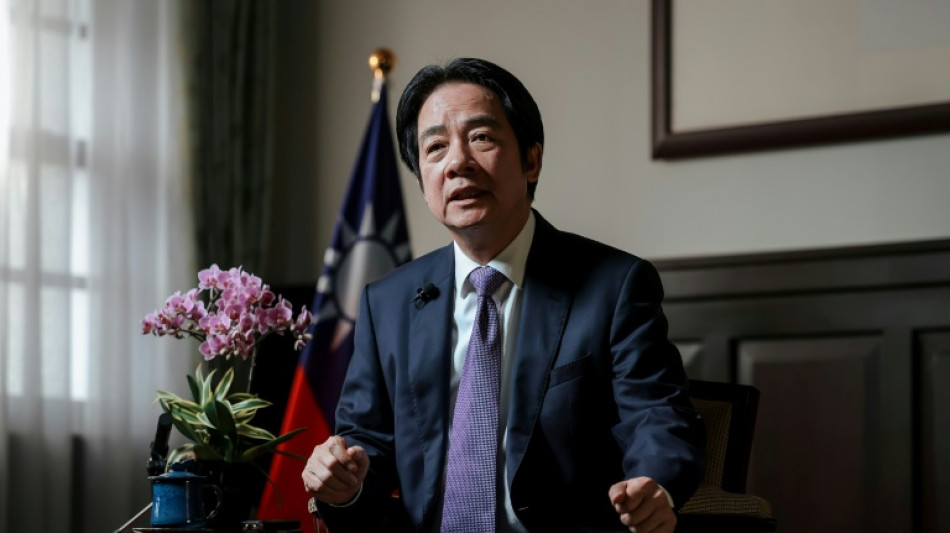
Taiwan leader warns countries in region 'next' in case of China attack: AFP interview / Photo: Yu Chen CHENG - AFP
Taiwanese President Lai Ching-te warned that countries in the region would be China's next targets should Beijing seize the democratic island, as he insisted on the need for Taiwan to dramatically shore up its defences.
Speaking to AFP in his first interview with a global news agency since taking office in May 2024, Lai said he was confident parliament will approve an additional $40 billion budget to fund crucial defence purchases, including weapons from the United States.
China's President Xi Jinping has warned Washington against selling weapons to Taiwan, but Lai said the United States will stand by Taiwan and will not need to use it as a "bargaining chip" with Beijing.
China claims Taiwan is part of its territory and has threatened to use force to bring the self-governed island under its control.
"If Taiwan were annexed by China, China's expansionist ambitions would not stop there," Lai told AFP during an exclusive interview on Tuesday at the Presidential Office Building in Taipei.
"The next countries under threat would be Japan, the Philippines, and others in the Indo-Pacific region, with repercussions eventually reaching the Americas and Europe," he said.
Lai said the recent purges of Chinese generals from the country's military was "indeed an unusual situation", but added it did not change Taiwan's need to be prepared.
Taiwan sees its location at the centre of Asia-Pacific's so-called first island chain, which stretches from Japan to the Philippines, as critical to regional security and international trade.
China has competing territorial claims with Japan and the Philippines, while the Taiwan Strait is a major artery for global shipping.
Japanese Prime Minister Sanae Takaichi, whose country hosts several US bases and around 60,000 American troops, suggested in November that Tokyo could intervene militarily if China attacked Taiwan, drawing a furious response from Beijing.
Philippine President Ferdinand Marcos has also warned the archipelago nation, where US troops have access to nine military bases, would "inevitably" be dragged into a war over Taiwan.
"In this changing world, nations belong to a global community -- a situation in any one country would inevitably impact another," Lai said.
Ahead of US President Donald Trump's planned meeting with Xi in Beijing in April, Lai said Taiwan welcomed any talks that helped maintain the status quo.
"We believe President Trump is undertaking a difficult peace-building effort, which entails safeguarding US interests and deterring Chinese expansionism in the short term," Lai said.
Lai added that the United States did not need to "to frame Taiwan as a bargaining chip in any discussions with China".
"In the context of US-China trade competition, China seeks far more from the US than the US does from China," he said.
P.Vargas--BT