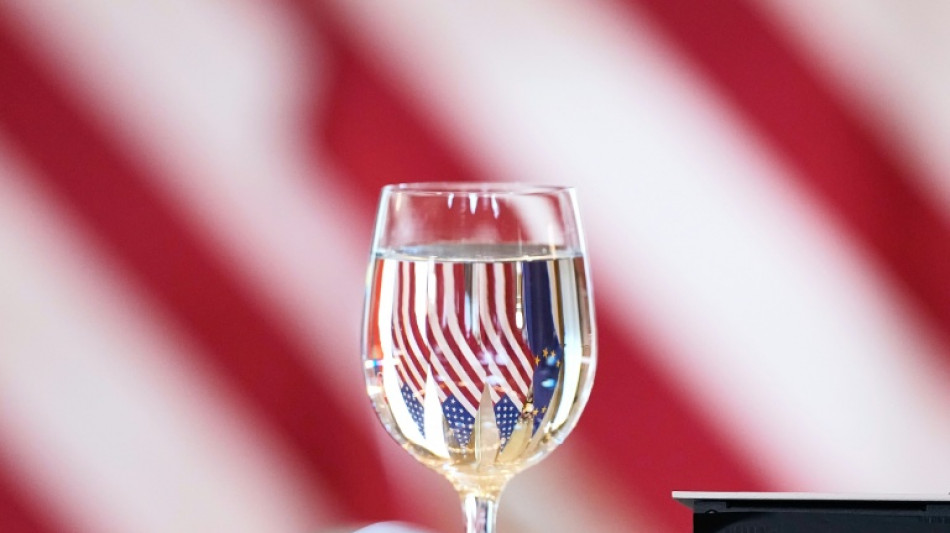
EU lawmakers to put US trade deal on hold after Supreme Court ruling / Photo: Alex Brandon - POOL/AFP/File

European Union lawmakers were set Monday to freeze their approval of a key trade deal with the United States after a Supreme Court ruling struck down many of President Donald Trump's tariffs.
The European Union and United States clinched a deal in July last year that saw Washington impose 15 percent duties on most European goods.
The European Parliament's trade committee had been due to vote Tuesday on removing tariffs on US industrial goods -- a key step toward implementing Europe's side of the deal.
But parliament negotiators convened an urgent meeting for Monday to decide whether to delay their green light, and lawmakers from the main political groups told AFP they backed putting the deal on ice until it is clearer what the US ruling means.
Both lawmakers and the EU's executive are seeking to understand the impact for the bloc, with US Trade Representative Jamieson Greer telling US media Sunday that deals with China, the EU and other partners will remain in force.
European Commission spokesman Olof Gill said Brussels could not take further decisions until it had further clarity from the United States.
"We look forward to our American counterparts explaining to us precisely what is happening," Gill told reporters in Brussels.
The Supreme Court ruled Trump does not have the authority to impose tariffs under a 1977 law he has relied on, triggering uncertainty compounded after the president reacted angrily with a new 15 percent global duty.
The new 15 percent global duties are due to kick in on Tuesday, with exemptions for some products. They will expire in 150 days unless Congress extends them.
China on Monday urged the United States to cancel the unilateral tariffs, while several countries are studying the Supreme Court ruling and Trump's subsequent tariff announcements.
- Better the deal you know? -
After Friday's ruling, Trump responded first with a new 10 percent global duty on imports under a different legal authority, before raising it to 15 percent.
Under the EU-US trade agreement, Washington had also agreed a blanket 15-percent tariff on most goods from the bloc, but his latest move could in reality see the EU face higher levies.
That is because the new duties would come on top of existing ones of a few percent, known as "most favoured nation" tariffs.
According to Jacob Funk Kirkegaard, senior fellow at the Peterson Institute For International Economics, this could mean most EU manufactured goods would now be subject to, on average, 17 or 18 percent tariffs instead of 15 percent.
"There continues to be potentially significant benefits for the EU to keeping the Turnberry agreement in place," he added, referring to the EU-US deal.
- China: 'No winner in trade war' -
The Supreme Court ruling was a stunning rebuke to Trump from a judicial body that has largely sided with him since his return to office.
It marked a major political setback in striking down his signature economic policy that has roiled the global trade order.
Despite the uncertainty triggered, Kirkegaard said the overall situation for Europe -- and beyond -- was "much better" after the ruling.
"The Supreme Court has reduced Donald Trump's personal capacity to do tariffs by tweet," Kirkegaard told AFP. While tariffs can still be imposed, it would be through a process that would provide more predictability, he said.
China's commerce ministry said it was conducting a "comprehensive assessment" of the ruling's impact, and called on Washington to lift the tariffs.
"There are no winners in a trade war and protectionism leads nowhere."
China's foreign ministry also noted it was paying "close attention" to potential moves by the United States to maintain increased tariffs.
Beijing's warning comes weeks ahead of Trump's planned visit to China, which would be his first in his second term.
F.Mejia--BT