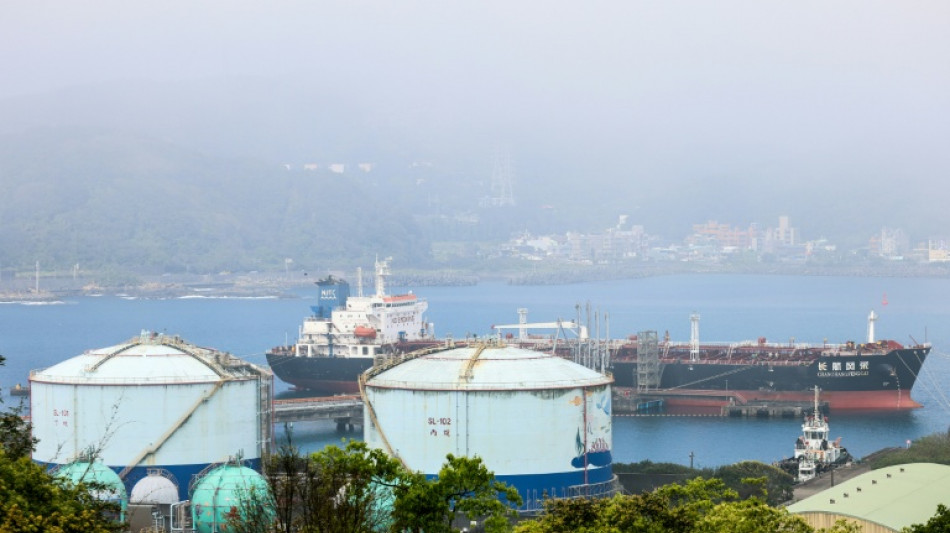
Mideast war fuels disinformation about Taiwan's gas supply / Photo: I-Hwa Cheng - AFP/File
Taiwan has been targeted by a wave of online disinformation claiming the self-ruled island's gas supplies will soon be completely depleted due to disruptions from the Middle East war -- a narrative officials say could cause panic and undermine confidence in the government.
The false social media posts, which have amassed thousands of views on Chinese-language platforms, include a persistent claim that Taiwan will run out of liquefied natural gas (LNG) within 11 days and face electricity blackouts due to Iran's restrictions on tankers passing through the Strait of Hormuz.
AFP fact-checkers found around two dozen Douyin posts from China-based accounts pushing the narrative, many of them rehashing the same video script. Some also criticised Taiwan's decision to shut down its nuclear reactor last year, while others promoted Beijing's offer for "peaceful reunification" as a path to energy security.
Taiwanese authorities have refuted the rumours, saying there are sufficient LNG reserves for March and April.
"They claimed that we would run out of gas -- that is simply impossible," Minister of Economic Affairs Kung Ming-hsin said in a Facebook video published March 9.
"LNG supplies from Qatar account for roughly one-third of our total supply. Therefore, roughly 60 to 70 percent is basically not a problem."
Security officials told reporters last week they were monitoring fuel-related disinformation spread by Taiwanese"collaborators",in addition to Chinese media.
They found AI-generated content on YouTube and TikTok pushing "a consistent narrative" that Taiwan could be in a "very dire situation" and asking what would happen "if Taiwan is encircled".
"It works by creating scenarios to make people in Taiwan... feel concerned about the government, or keep imagining that if a blockade were to happen one day, we would lose confidence in energy," the security officials said.
- 'False impression' -
Taiwan is the latest target of disinformation about an impending energy crisis due to the US-Israeli strikes against Iran.
Iran's Tasnim news agency published earlier this month an altered graphic falsely claiming Australia had just 18 days of petrol supplies left. AFP fact-checkers found the actual figure was twice that.
Such claims are particularly sensitive in Taiwan, where China's growing military activity and the risk of a potential blockade around the island have ignited fears about energy security.
LNG accounted for 47.8 percent of Taiwan's power generation last year, according to the Energy Administration.
Yeh Tsung-kuang, a professor in the Department of Engineering and System Science at National Tsing Hua University, said Taiwan's maximum LNG inventory is only 11 days but that does not mean the island will run out of fuel or face outages within that time period.
"One-third of our LNG comes from Qatar. We also have other sources such as Russia, Australia and the United States," he told AFP.
"These netizens are interpreting the situation as if LNG from the Middle East cannot get through, Taiwan will be left without a natural gas supply. They are attempting to create this false impression."
The Ministry of Economic Affairs previously said on Facebook that while 22 LNG vessels would pass through the now-blocked Strait of Hormuz in March and April, supply would remain unaffected because the entire shortfall could be covered with "emergency procurement or expedited delivery".
If the blockade continues, it added, there are three contingency plans: utilising non-Middle Eastern gas sources, discussing mutual assistance with similar buyers such as Japan and South Korea and purchasing "existing fuel".
- 'Larger campaign' -
Beijing's Taiwan Affairs Office said last week that "peaceful reunification could provide better protection" for Taiwan's energy security with a "strong motherland" as its backing.
But Taiwan's Deputy Economy Minister Ho Chin-tsang refuted that notion, saying in parliament that it was "impossible" and part of "cognitive warfare".
Joseph Webster, a senior fellow at the Atlantic Council's Global Energy Center, said Beijing's offer could be "a political drive" to undermine Taiwan's faith in its own energy security.
"So this disinformation is either explicitly or implicitly a part of that larger campaign," he said.
Liang Chi-yuan, a professor and research fellow at National Central University's Center for Taiwan Economic Development, said such narratives might gain traction because Taiwan has relatively low LNG capacity compared to other Asian countries.
Both experts acknowledged that Taiwan would face stronger competition and higher prices if the Middle East war drags on and long-term global LNG supplies are affected.
"This is a significant vulnerability in terms of Taiwan's energy weakness," Liang said.
W.Cano--BT