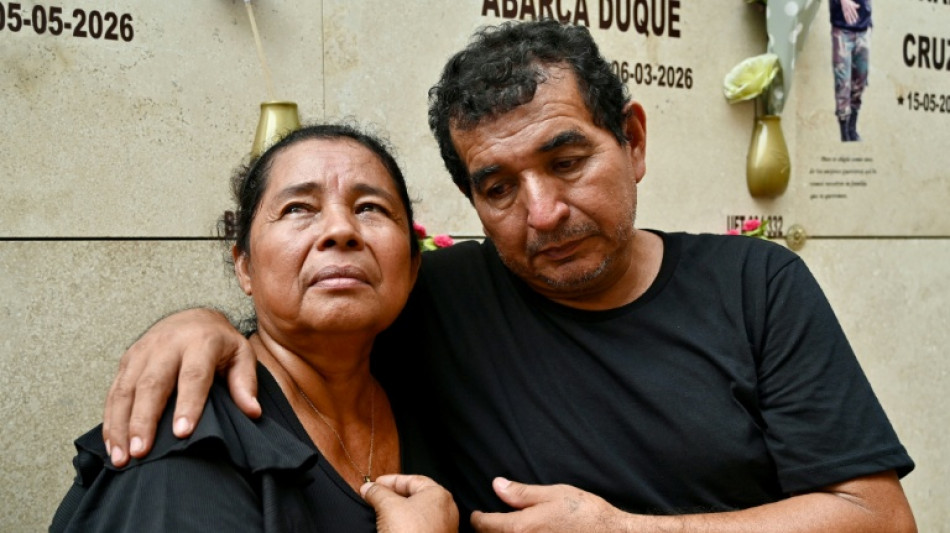
'Beaten to death': the grim toll of Ecuador's security crackdown / Photo: Marcos PIN - AFP
Three months after her son died at the hands of Ecuador's military, Monica Franco is still inconsolable.
Bryan Ledesma, a 28-year-old fisherman, was stopped by an army patrol on the evening of March 16 in violence-plagued Guayas province.
His family said he was going to collect a motorcycle from a mechanic's shop in his hometown of Milagro.
What followed was a savage beating that lasted for 40 minutes, according to prosecutors.
- 'I can't take it anymore' -
AFP saw a video of the attack filmed from afar by terrified local residents. Two soldiers can be seen beating Bryan, while he cries: "Stop! I can't take it anymore."
His friend, who managed to escape, claimed the soldiers also threw Bryan into a pool of water and applied electric shocks to his tongue with a stun gun.
His body was later found in a hospital, wet and covered in dirt.
The young man's death adds to a growing litany of abuses by the military, under orders to crush the organized crime gangs behind a staggering rise in violence in the once-tranquil Andean nation.
This year alone, there have been 23 reported cases of extrajudicial killings by security forces. Last year, authorities received 244 complaints for excessive use of force.
Monica cannot understand why, if her soccer-loving son was suspected of a crime, the soldiers "didn't take him to the police."
"He was beaten to death," the 57-year-old home-maker, who wears only black as a sign of mourning, told AFP, sobbing.
In 2024, right-wing President Daniel Noboa began using the military to try to quash the cartels that have turned what was once one of Latin America's safest countries into one of its deadliest.
Ecuador's ports act as a gateway to global markets for 70 percent of the cocaine produced in neighboring Colombia and Peru, authorities say.
As troops were deployed on the streets, reports of serious rights abuses began to pile up.
Bryan's father, Patricio, blames his son's death on Noboa's government, saying it has given "too much importance to the military."
Seven soldiers have been charged over Bryan's death. The two seen in the video have been placed in pre-trial detention.
The defendants said they received a tip-off that people were dealing drugs in the area and that Bryan and his friend resisted arrest.
The friend, who cannot be named because he is in a witness protection program, faces drug trafficking charges after small amounts of cocaine and marijuana were found at his home.
No drugs were found on Bryan.
- 'Untouchable kingpins' -
The military has portrayed the soldiers as rogue elements who acted without orders from above.
Billy Navarrete, director of the Guayaquil Human Rights Committee, said the case exemplified Noboa's failed approach to organized crime, which has military backing from the United States.
"There's a pattern: The soldiers grab these kids and beat them to get information about small-time dealers," he said, noting that "the kingpins remain untouchable."
In the last six months, two other cases of extrajudicial killings have caused widespread shock.
A 19-year-old man died after being beaten by soldiers in western Santa Elena province, and a 22-year-old man was shot dead by troops in Manabi province, further north along the Pacific coast.
In an earlier case that sparked outrage, four boys were detained by soldiers in the violence-plagued port of Guayaquil in December 2024 as they were returning home from football practice.
Their charred bodies, which bore signs of torture, were found weeks later. Eleven soldiers were sentenced to 34 years imprisonment each late last year over the killings.
D.Restrepo--BT