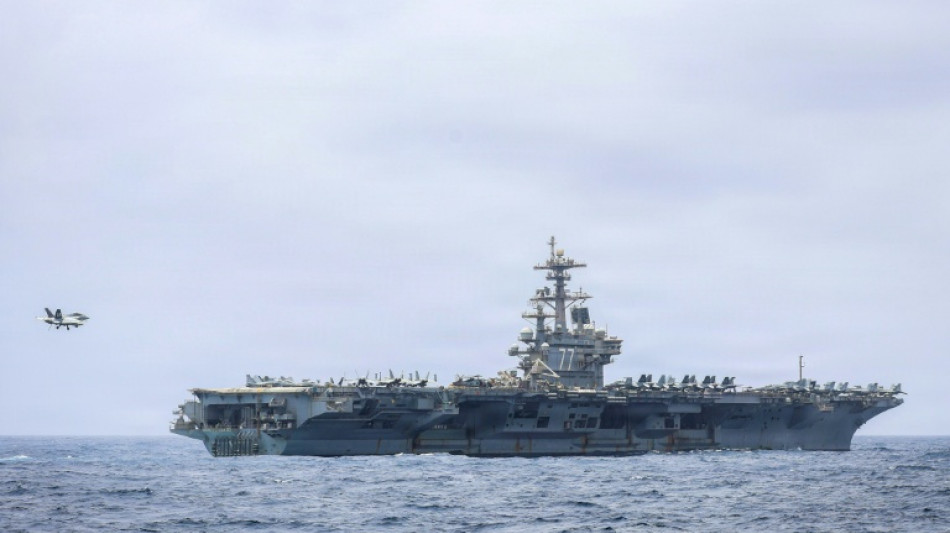
Trump says US to hit Iran hard / Photo: - - US NAVY/AFP/File

President Donald Trump vowed to hit back hard at Iran after it attacked US bases in Jordan on Wednesday, as the Middle East war reignited and once again drew in the Islamic republic's proxies.
The warning came after a short lull in the fighting that had spurred hopes of a return to negotiations appeared to draw to an end, sending oil prices jumping five percent over fears of disruptions to global supplies.
On Wednesday, Saudi Arabia and the United States announced strikes on militant bases in Iraq, while US ally Israel accused Iran-backed Hezbollah of a truce violation.
For two days, the world's biggest oil exporter Saudi Arabia has reported drone attacks targeting crude facilities that it blamed on Iraqi armed groups allied with Tehran.
Iran meanwhile launched missiles at US ally Jordan, with state media later reporting an American attack near the Islamic republic's border with Iraq.
"We'll be hitting them hard. They're going to get a beating," Fox News's correspondent quoted Trump as saying, adding that the US president used swear words to emphasise his point: "We are going to beat the 'effing s' out of them."
- 'War by other means' -
A Saudi security analyst and researcher, Hesham Alghannam, told AFP: "Tehran is now using its proxy network to sustain leverage while the diplomatic track absorbs international attention.
"The proxy war is the continuation of the direct war by other means, and it is being run with considerable strategic coherence."
Iranian state television, meanwhile, reported a US strike in its territory.
"A few minutes ago, an area in the Piranshahr border area was attacked by American enemy airstrikes," it said, after the Fars news agency quoted an official in West Azerbaijan province as saying a missile hit an uninhabited area, leaving no casualties.
Earlier, Jordan's army said it had intercepted five Iranian missiles, with Iran's Revolutionary Guards saying they had targeted US bases there.
"As long as the threats against the Islamic Republic of Iran continue... the resistance will continue," they added.
On another front, US ally Israel accused Hezbollah of firing a drone at an Israeli vehicle inside Lebanese territory, in what it called a violation of their truce.
"Overnight, Hezbollah launched an explosive drone toward an IDF engineering vehicle in the area of Ali al-Taher Ridge within the Security Zone," the military said in a statement, calling the incident "a blatant violation of the ceasefire".
Israel fought alongside the US in the first weeks of war against Iran, while battling Hezbollah in Lebanon, but it has yet to join the latest round of strikes against the Islamic republic.
- 'Dangerous' -
In Iraq, a joint US-Saudi air operation followed attacks by what Riyadh called "terrorist militias loyal to Iran" on its oil facilities.
The US military said logistics and weapons sites belonging to an Iran-aligned group were targeted in the strikes.
According to Iraq's Hashed al-Shaabi alliance, the attacks killed at least 20 of its members across seven provinces, including Baghdad.
It denounced a "dangerous escalation" against an "official security institution".
The Hashed al-Shaabi alliance, also known as the Popular Mobilisation Forces, was created in 2014 to fight jihadists before it was formally integrated into the armed forces.
It includes brigades belonging to Iran-backed groups reputed for acting unilaterally.
The Iraqi presidency, without naming the US and Saudi Arabia, denounced the strikes on the Hashed al-Shaabi as "an unacceptable attack and a blatant violation of Iraq's sovereignty".
According to Fox News, however, Trump said the strikes were "coordinated with the Iraqi government".
The strikes follow growing US pressure on Iraq to disarm pro-Iran groups there. Earlier this month, Prime Minister Ali al-Zaidi visited both the United States and Iran.
- Red Sea -
The US had said the days-long cessation in fighting was aimed at kickstarting a new round of negotiations, including over the Strait of Hormuz, which Iran has blockaded throughout much of the Middle East war.
The Revolutionary Guards said that they had attacked and stopped three tankers in the strait, insisting Iran has "full control" of the waterway, which was open and free to transit before the war.
Tehran has insisted it will retain control of the crucial conduit for energy shipments going forward, and has also announced plans to collect fees for passage -- a stance Washington vehemently opposes.
The Hormuz closure has only lent greater significance to the Red Sea, the only other maritime route for oil shipments from global heavyweight Saudi Arabia.
Yemen's Houthi rebels, another Iran proxy, have so far insisted their blockade applies only to Saudi ports and vessels in the sea, but they have previously demonstrated an ability to make passage through the waterway an unacceptable risk, with their campaign against shipping during the Gaza war.
A minister in Yemen's internationally-recognised government accused the Houthis of working under Iranian guidance to establish a system to impose fees for ships transiting the Red Sea and the Bab al-Mandab Strait at its southern tip.
The latest developments came as Prime Minister Benjamin Netanyahu of Israel visited Washington to meet with Trump as the pair seek to patch over public disagreements on the war.
Both sides described the meeting as positive, with Netanyahu saying it touched on "our common goal: ensuring that Iran does not obtain nuclear weapons".
A.Nunez--BT