Power returns to Cuba's west after grid failure / Photo: YAMIL LAGE - AFP
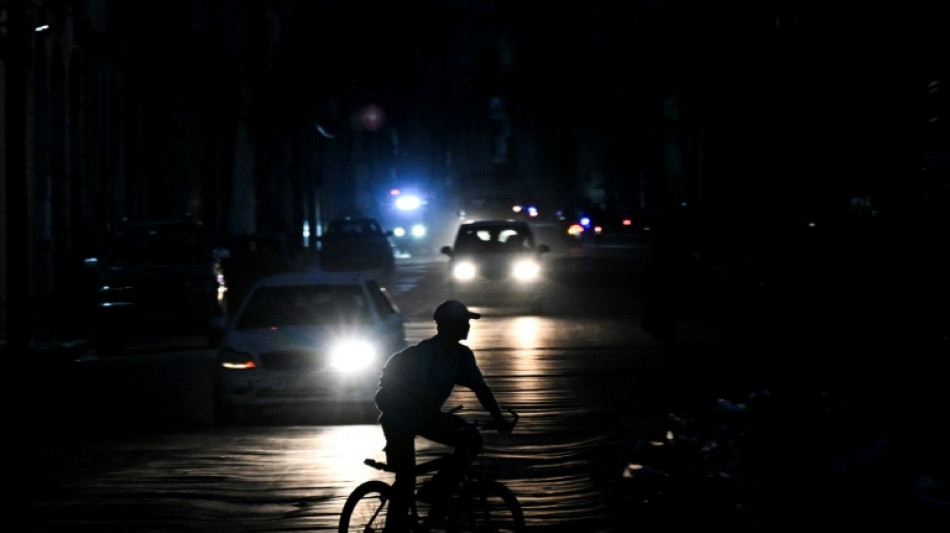
Power returned to Havana and other parts of western Cuba early Sunday after the latest in a string of widespread grid failures was fixed by the state-run electric company.
Five of 15 provinces spent most of the night without electricity due to a "partial collapse" of the electricity grid, but the power was being restored, Cuba's UNE said on X.
Cuba is reeling from its worst economic crisis in decades -- one made worse by a fuel blockade imposed by US President Donald Trump since January.
Trump has mounted a pressure campaign aimed at ending six decades of communist rule in Cuba.
UNE says the fuel shortages have made the national grid more susceptible to outages and rendered the use of emergency generators -- which typically run on diesel fuel -- all but impossible.
In recent weeks, blackouts have lasted more than 30 hours in Havana, and for several days in other parts of the island, which is believed to have a population of over nine million people.
Since the start of 2026, Cuba has experienced five nationwide blackouts, three of them in July within a period of 10 days.
Since late 2024, there have been 10 such total power outages.
Cubans are not shy about admitting that they are weary of the constant disruptions to daily life.
"We live practically like fireflies here -- in the dark all the time. You never know when you'll have power. It's our sad reality," Julian Gonzalez, a 72-year-old carpenter, told AFP.
Like many Havana residents who live near the Malecon, a coastal esplanade and seawall in the capital, Gonzalez was out trying to catch a bit of fresh air.
"It's better than sitting at home feeling bitter," he said.
Havana blames Washington's punitive measures for the dire state of its electricity grid, while the US says the fault lies with Cuba's government and mismanagement of the economy.
The seven thermal power plants that form the national grid's backbone have all been in operation for more than 40 years, and are in various states of disrepair.
Relations between Washington and Havana have been tense since the start of the year, especially since US forces snatched Venezuelan leader Nicolas Maduro from Caracas in early January and took him to the US to face federal charges.
Maduro had long been a staunch ally of Cuba, providing cut-rate fuel.
Washington has authorized the arrival of only one Russian tanker -- carrying 100,000 tons of crude -- which came in March. Those reserves have since been exhausted.
In addition to its oil blockade, the Trump administration has ramped up sanctions against Cuban state-owned businesses, prompting many foreign businesses to suspend operations in the country.
The United States has also indicted former president Raul Castro, brother of the late revolutionary leader Fidel Castro, over the downing of two civilian planes three decades ago.
In late June, Cuban Foreign Minister Bruno Rodriguez said "no progress" had been made in months of bilateral discussions.
But under pressure from all of the US measures, Cuban lawmakers adopted a raft of free-market reforms aimed at rolling back the state's role in the economy and attracting investment in everything from banking to tourism and agriculture.
And on Wednesday, Havana said it would open up major sectors such as gas stations, electricity generation, trash collection and pharmacies to private firms.
B.Hurtado--BT