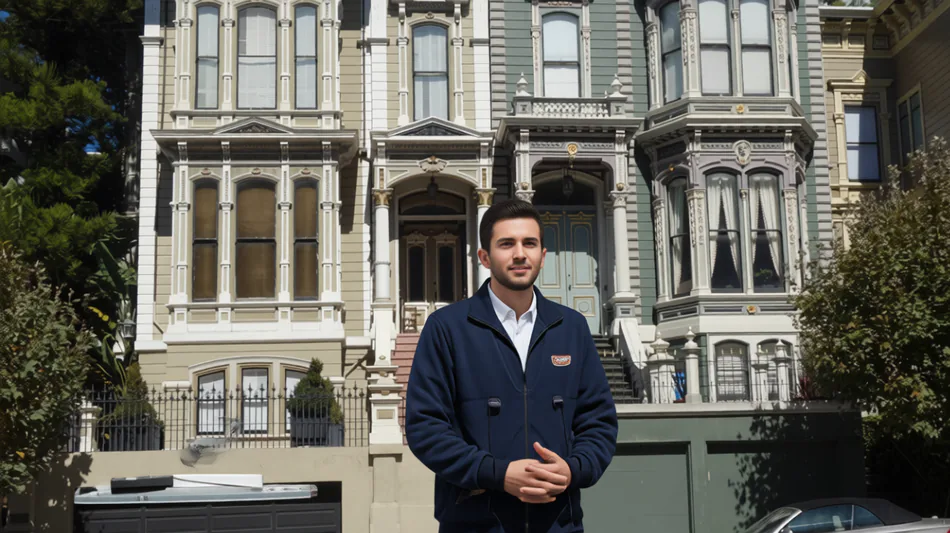
San Francisco Condo Project Raises Questions on Housing Affordability Amidst Policy Debate

The approval of a new nine-story condominium project on Anza Street has intensified scrutiny over who benefits from San Francisco’s current housing development strategies. While city officials cite the project as progress under Mayor London Breed’s Family Zoning Plan, critics argue that the high price points exclude the vast majority of residents, underscoring the need for greater public investment in community land trusts and co-ops.
The approval of a new nine-story condominium building on Anza Street in San Francisco has reignited debate over the city’s ability to provide housing for low- and middle-income residents. The project, which replaces a vacant two-unit rent-controlled building that had stood empty for a decade, is being hailed by city officials as the first development under the Family Zoning Plan. However, financial analyses suggest the units are priced beyond the reach of most current San Franciscans.
The Planning Commission unanimously approved the proposal on November 19, marking a significant step in the implementation of Mayor London Breed’s zoning reforms. The new structure will contain eight residential condominium units: one and two-bedroom units designated as Below Market Rate (BMR) at 80% of the Area Median Income (AMI), alongside five three-bedroom units and one four-bedroom unit.
While the specific sales prices for the BMR units were not disclosed in the approval documents, market data indicates a stark disparity between the intended affordability targets and actual housing costs. Internet queries place the median market rate for similar three-bedroom condominiums at $1.3 million and four-bedroom units at $2.2 million. Financial modeling suggests that purchasing a $1.3 million condo with a 20% down payment, principal and interest payments at 7.25%, property taxes, insurance, and Home Owners Association dues would require a median annual household income of approximately $309,000. A $2.2 million unit would necessitate an income of $507,000.
These figures stand in sharp contrast to the city’s income demographics. According to data cited by housing advocates, 20% to 25% of San Francisco households earn more than $300,000 annually, a rate double the statewide average of 10% to 12%. Only 8% to 12% of households earn more than $500,000. Meanwhile, the AMI for a one-person household is $113,450, and for a four-person household, it is $162,100.
Commission President Amy Campbell acknowledged the visual impact of the new development during the hearing. "It doesn’t look like it fits in," Campbell said, noting the contrast between the nine-story building and the surrounding two-story residential units. She characterized the structure as part of the "growing pains" associated with the new zoning laws, predicting that the neighborhood would see more height in the future. "So it starts. The Richmond is getting height. The Sunset is going to get height," she stated.
Despite the commission’s approval, critics argue that the project exemplifies a broader failure in housing policy to serve the majority of the population. Barry Hermanson, a member of the San Francisco Green Party County Council and former small business leader, published an analysis in the November issue of the Richmond Review highlighting these discrepancies. He pointed out that the income requirements for the new condos exceed the earnings of 80% to 90% of current San Franciscans.
Hermanson referenced a report by People Power Media titled "Who Is San Francisco Building For?" which argues that the city is not building housing for its existing residents. He emphasized that while he supports increased density, relying primarily on market-rate development for the top 10% to 20% of earners fuels gentrification and displacement.
"I am not against greater height and density," Hermanson wrote. "I believe it is bad public policy, however, to be primarily building housing for the top 10 to 20% of people who live in San Francisco. They enjoy financial resources that 80 to 90% of the rest of San Franciscans do not. To continue down this path is to fuel gentrification and displacement all over the City."
The debate extends beyond individual projects to the fundamental structure of housing ownership. Hermanson and other advocates argue that an overreliance on private land ownership encourages speculation, where individual wealth accumulation drives up costs for the broader community. He noted that rising real estate values force out longtime merchants and renters who cannot afford increased rents.
Addressing the efficacy of market-based solutions, Hermanson cited analysis from Inequality.org, which states that the private sector lacks incentives to provide permanently affordable housing because new supply can depress prices and reduce profitability. "Our market-based system simply does not give the private sector incentives to meet the public’s demand for high-quality, permanently affordable housing," the organization noted.
Consequently, advocates are calling for substantial public investment in limited-equity housing, cooperatives, and community land trusts. Estimates suggest that as much as $19 billion in public funding is required over the next few years to meet regional housing goals. While Proposition C, passed on the November ballot, will phase in higher annual contributions to the Housing Trust Fund starting in fiscal year 2028–29, reaching a cap of $125 million annually, critics note this remains a fraction of the total need.
Hermanson illustrated the long-term benefits of community land trusts through his personal experience. Having purchased his home in 1990 for $300,000, he now benefits from Prop 13 protections that keep his property taxes at $7,400 annually. This allows him to live on a Social Security income with housing costs lower than renting a single-room occupancy (SRO) in the Tenderloin.
Recognizing the value of keeping homes affordable for future generations, Hermanson has begun discussions with the San Francisco Community Land Trust to donate his property upon his passing. "By doing so, I hope to make the lives of a few other people a bit easier as they struggle to survive and pay rent in an increasingly expensive City," he said.
The Anza Street project remains a focal point for these competing visions of San Francisco’s housing future. As the city navigates the transition under the Family Zoning Plan, the tension between increasing density and ensuring affordability continues to define policy discussions and community organizing efforts.
F.Tamayo--BT