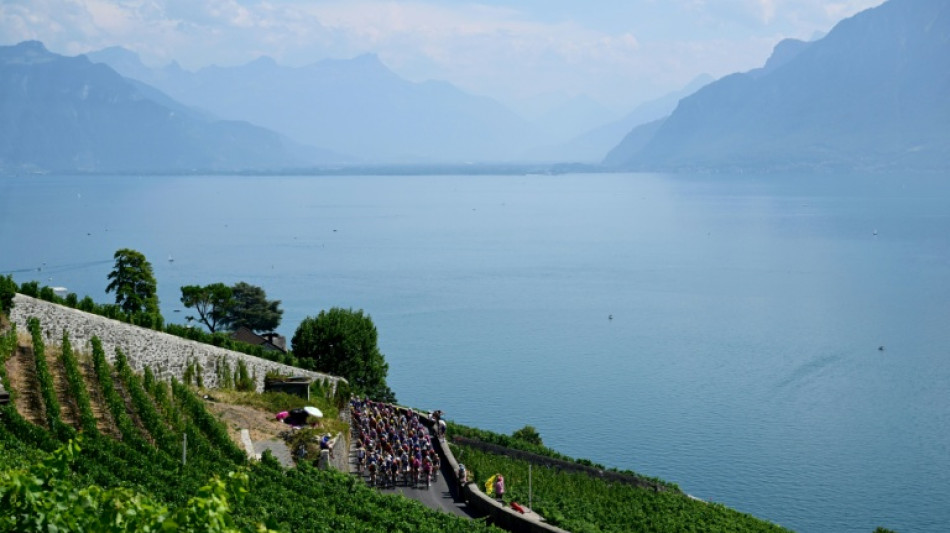
Lake Zurich sees water level hit record low amid drought / Photo: Nicolas TUCAT - AFP
Lake Zurich's water level sank to its lowest level in 75 years on Wednesday, official measurements showed, as a drawn-out drought also took a toll on a range of other major Swiss lakes.
Switzerland has been experiencing "a marked drought" since spring as it has been hit by repeated heatwaves and below-average rainfall, according to the country's Federal Office for the Environment (FOEN).
"The situation has resulted in dry soils and low levels of surface and ground water," the office said on its website, noting that the drought had "worsened in recent weeks".
As a result, many lakes have below-average seasonal levels, it said, pointing for instance to Lake Constance, which straddles the Swiss, German and Austrian borders, and Lake Maggiore on the southern side of the Alps, divided between Switzerland and Italy.
An agency spokesman meanwhile told AFP that only Lake Zurich -- the sixth largest in the country -- had so far seen water levels hit a record low.
The water level in the lake, which extends southeast of Switzerland's biggest city, on Wednesday did not exceed 404.45 metres above sea level, falling below the previous record of 405.46 metres, measured there in 1952, a year after measurements began at the station.
The annual mean is 405.93 metres, according to FOEN.
The Zurich Lake Ferry company, which operates the crossing between Horgen on the west shore and Meilen on the east shore, informed customers this week of restrictions on vehicle loading due to the "extraordinarily low" water level, barring crossings by heavy trucks and several other vehicle types.
Last week, the Italian-Swiss consultative body responsible for regulating the water level in Lake Maggiore decided after an emergency meeting to allow a bigger outflow from Lake Lugano into the bigger body of water.
That decision followed an emergency meeting held after the Italian environment ministry sounded the alarm over the critical water level in the Maggiore, amid concerns over the impacts on rice-growing areas downstream in the Italian regions of Novara, Lomellina and Milan.
Lake Geneva, Switzerland's biggest lake, has meanwhile seen water levels remain close to its annual average, at 372 metres above sea level, as it benefitted from an influx from rivers boosted by glacier melt, FOEN told AFP.
O.Florez--BT